







News
How Underground Fault Indicators Enhance Grid Reliability
Date:2025-11-28
In modern power distribution networks, grid reliability is no longer just a performance metric—it is a core expectation from utilities, industries, and end users. As urban areas expand and more distribution lines move underground, efficiently identifying and locating cable faults becomes increasingly critical. This is where underground fault indicators play an essential role.
In this article, we explore how underground fault indicators operate, why they matter, and how they significantly improve the stability and reliability of underground power systems.
1. The Challenge of Underground Cable Faults
-
Unlike overhead lines, underground cables are difficult and time-consuming to inspect. When a fault occurs:
- Technicians must manually inspect long cable sections
- Fault location can take hours or even days
- Restoration teams often rely on trial-and-error troubleshooting
- Repair delays cause extended outages and customer dissatisfaction
With growing cable networks, traditional inspection methods are no longer efficient.
2. What Are Underground Fault Indicators?
Underground fault indicators are intelligent devices installed inside cable distribution cabinets, switchgear, or cable joints. Their primary functions include:
-
- Detecting short-circuit and earth faults
- Displaying fault direction via LED indicators
- Transmitting fault alarms through wireless communication or SCADA
- Helping teams locate the fault section quickly
-
3. How Fault Indicators Enhance Grid Reliability
- Faster Fault Location:Instead of searching blindly, maintenance teams can locate the fault within minutes by following indicator status changes along the route.
Improved Fault Isolation:By identifying the exact fault section, operators can quickly isolate faulty segments and restore power to unaffected areas.
- Enhanced Monitoring and Early Warning:They provide real-time alarms, historical logs, and load data—helping utilities detect problems earlier and plan maintenance more effectively.
- Increased Operational Safety:Fault indicators reduce the need for manual cable testing and unnecessary digging, minimizing safety risks for field engineers.
-
4.Application Scenarios
- Underground fault indicators are widely used in:
- Urban distribution networks
- Commercial and industrial parks
- Hospitals and airports
- Metro and railway power systems
- Residential underground cable grids
- Ring Main Units (RMU) and pad - mounted switchgear
Wherever outages are unacceptable, fault indicators become essential.
5. Key Features to Look For
When selecting underground fault indicators, utilities often consider:
- High detection accuracy (short-circuit & earth fault)
- Compatibility with RMU, switchgear, or cable joints
- Wireless communication (LoRa, NB-IoT, 4G/5G)
- Self-powered or long-life battery options
- IP-rated waterproof housing
- Low maintenance and long lifespan
- Choosing the right indicator improves long-term grid performance and reduces operational costs.
-
6.Four-Faith Power Underground Fault Indicator Solutions
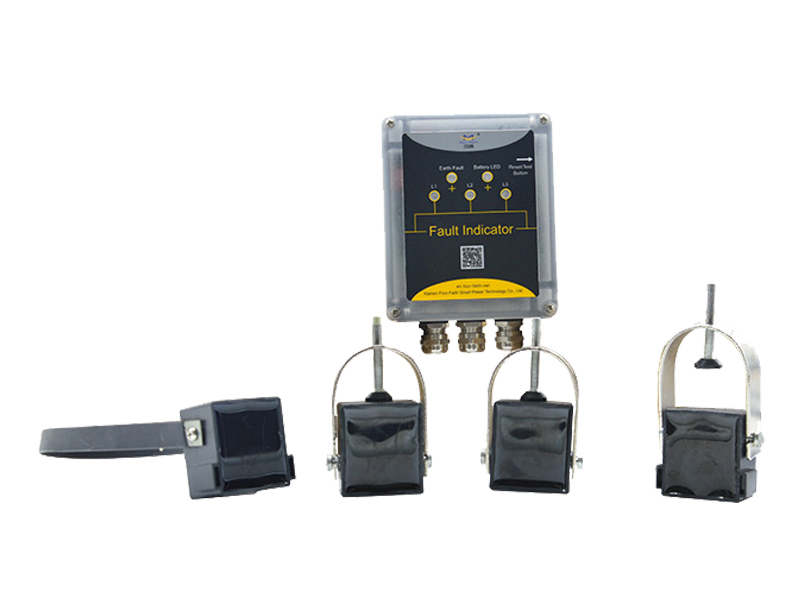
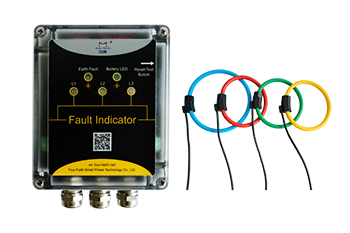
To improve reliability in modern underground power distribution networks, Four-Faith Power provides high-precision Underground Fault Indicators, including the DYO‑FF‑FI and DYO‑FF‑FIS models, designed for RMUs, switchgear, and underground cable compartments. These indicators enable fast, accurate fault detection and minimize downtime.
DYO‑FF‑FI Underground Fault Indicator- Detects short-circuit and earth faults quickly
- High-brightness LED for visual fault location
- Flexible installation on various cable compartments
- IP-rated waterproof housing
- Ultra-low power consumption and long battery life
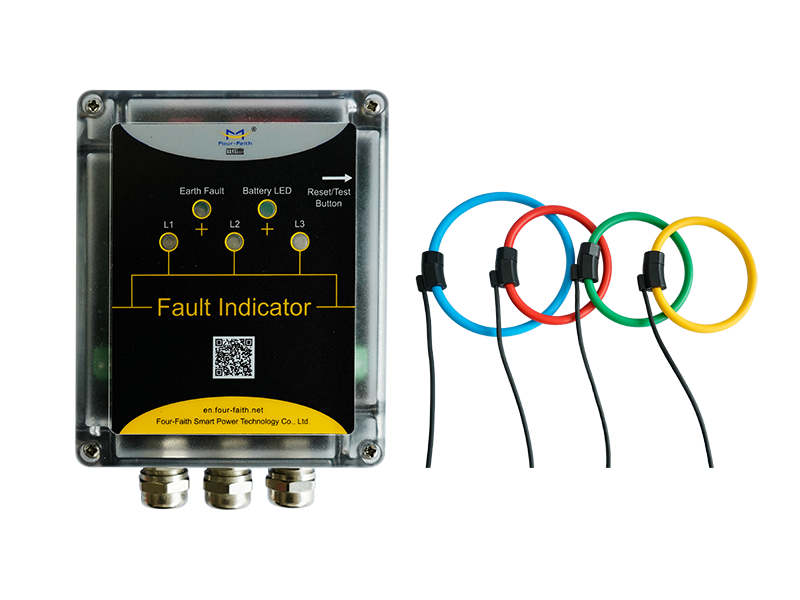
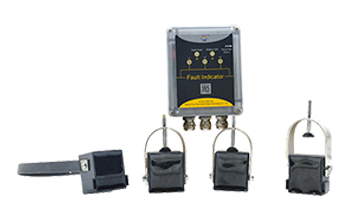
DYO‑FF‑FIS Underground Fault Indicator - Rogowski-coil based sensors for high-sensitivity fault detection
- Ideal for precise ground fault localization
- Supports SCADA integration for remote monitoring
- Self-diagnosis, event logging, and low-battery reminders
- Easy installation and maintenance
These products are widely deployed in urban grids, industrial parks, airports, metro systems, and smart distribution networks, helping utilities locate faults rapidly, reduce maintenance risks, and ensure grid reliability.
Conclusion
Underground fault indicators are a simple yet powerful investment for modern power distribution networks. By enabling rapid fault detection, supporting remote monitoring, and improving system resilience, they play a crucial role in enhancing overall grid reliability.
As power systems continue to evolve, these devices will remain essential tools for utilities seeking to deliver stable, efficient, and interruption-free energy to their customers.

top
- Products
- Distribution Automation
- Outdoor Apparatus
- Fault Circuit Indicator
- Industrial Wireless Communication
- Software
- Solutions
- Utility Solutions
- Infrastructure Solutions
- Services
- Documents & Software
- Support
- Business Case
- Video
- about us
- Company
- Contact us
- Subscribe
- Career

Mobile viewing


© Copyright 2026 by www.fourfaithpower.com. All Rights Reserved. 闽ICP备08106834号-8