





News
What Is a Feeder Protection Relay?
Date:2026-09-02
A reliable power distribution system needs to detect electrical faults quickly and isolate the affected section before a fault causes equipment damage, power outages, or safety hazards. A feeder protection relay is one of the key devices responsible for this task.
But what exactly is a feeder protection relay? How does it work, what faults can it detect, and why is it important for medium-voltage power distribution systems?
In this guide, we explain the definition, working principle, protection functions, applications, and key considerations for selecting a feeder protection relay.
What Is a Feeder Protection Relay?
A feeder protection relay is a protective device used to monitor and protect electrical feeders in power distribution systems.
A feeder carries electrical power from a substation, switchgear, or distribution point to downstream loads. If a short circuit, earth fault, overload, or other abnormal electrical condition occurs on the feeder, the protection relay detects the abnormal condition and can send a trip signal to the associated circuit breaker.
The basic protection process is:
Measure → Detect → Decide → Trip → Isolate
The relay continuously receives electrical measurements from current transformers (CTs), voltage transformers (VTs), or other sensors. It compares these measurements with predefined protection settings. When the detected condition meets the configured fault criteria, the relay operates the circuit breaker to disconnect the affected feeder.
The main objective is to isolate faults quickly while keeping healthy sections of the power distribution network in operation.
What Does a Feeder Protection Relay Do?
A feeder protection relay performs several important functions in a power distribution system.
Its main functions can include:
- Detecting short circuits
- Detecting overcurrent conditions
- Detecting earth faults
- Determining the direction of fault current
- Monitoring voltage abnormalities
- Protecting against phase imbalance
- Sending trip commands to circuit breakers
- Recording fault and event information
- Measuring electrical parameters
- Communicating with monitoring and automation systems
The exact functions depend on the relay model and the requirements of the electrical network.
Modern numerical feeder protection relays can combine protection, measurement, control, communication, and fault recording functions in a single device.
Four-Faith Feeder Protection Relay Solutions
For utilities, industrial facilities, and power distribution projects looking for reliable feeder protection, Four-Faith Smart Power provides a range of feeder protection relays designed for distribution network protection, control, measurement, communication, and automation.
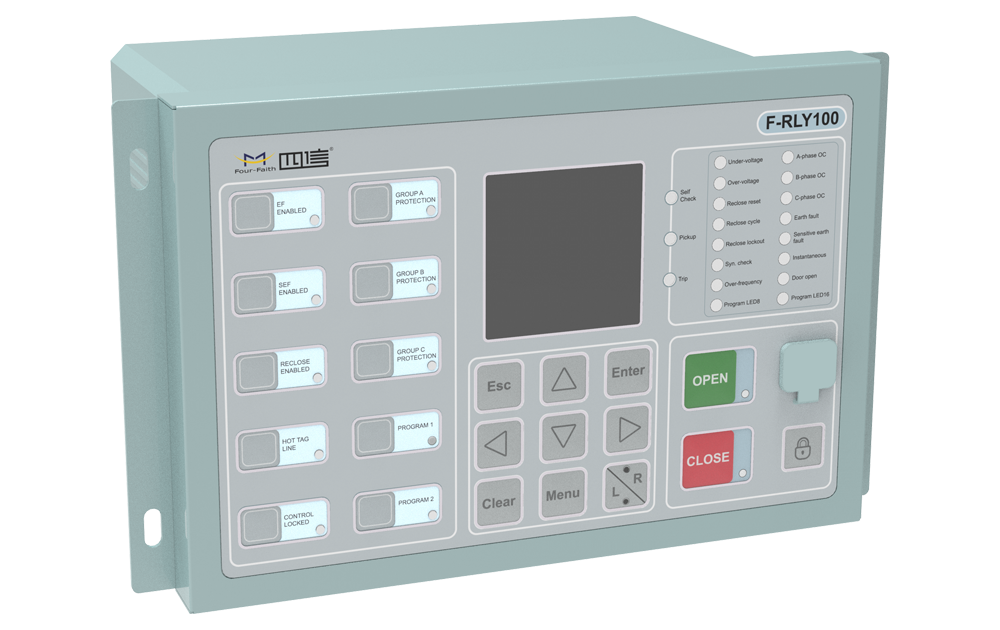
Four-Faith's protection relay portfolio includes the F-RLY100, F-RLY100L, and F-RLY200, covering different requirements for overhead lines, cable lines, utility distribution systems, industrial power systems, Ring Main Units (RMUs), Feeder Terminal Units (FTUs), and primary switchgear.
F-RLY100 Feeder Protection Relay
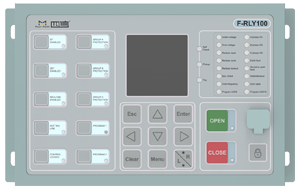
The F-RLY100 is designed for overhead and cable line applications and serves as a core component of Feeder Terminal Units (FTUs), Ring Main Units (RMUs), and Primary Switchgears (PSGs).
It integrates multiple functions into one device, including:
- Protection
- Control
- Measurement
- Communication
- Data processing
- Power management
This integrated architecture allows the F-RLY100 to support both feeder protection and broader distribution automation requirements.
For distribution networks that require reliable fault protection together with monitoring and communication capabilities, the F-RLY100 can provide an integrated solution for feeder-level applications.
F-RLY100L Feeder Protection Relay
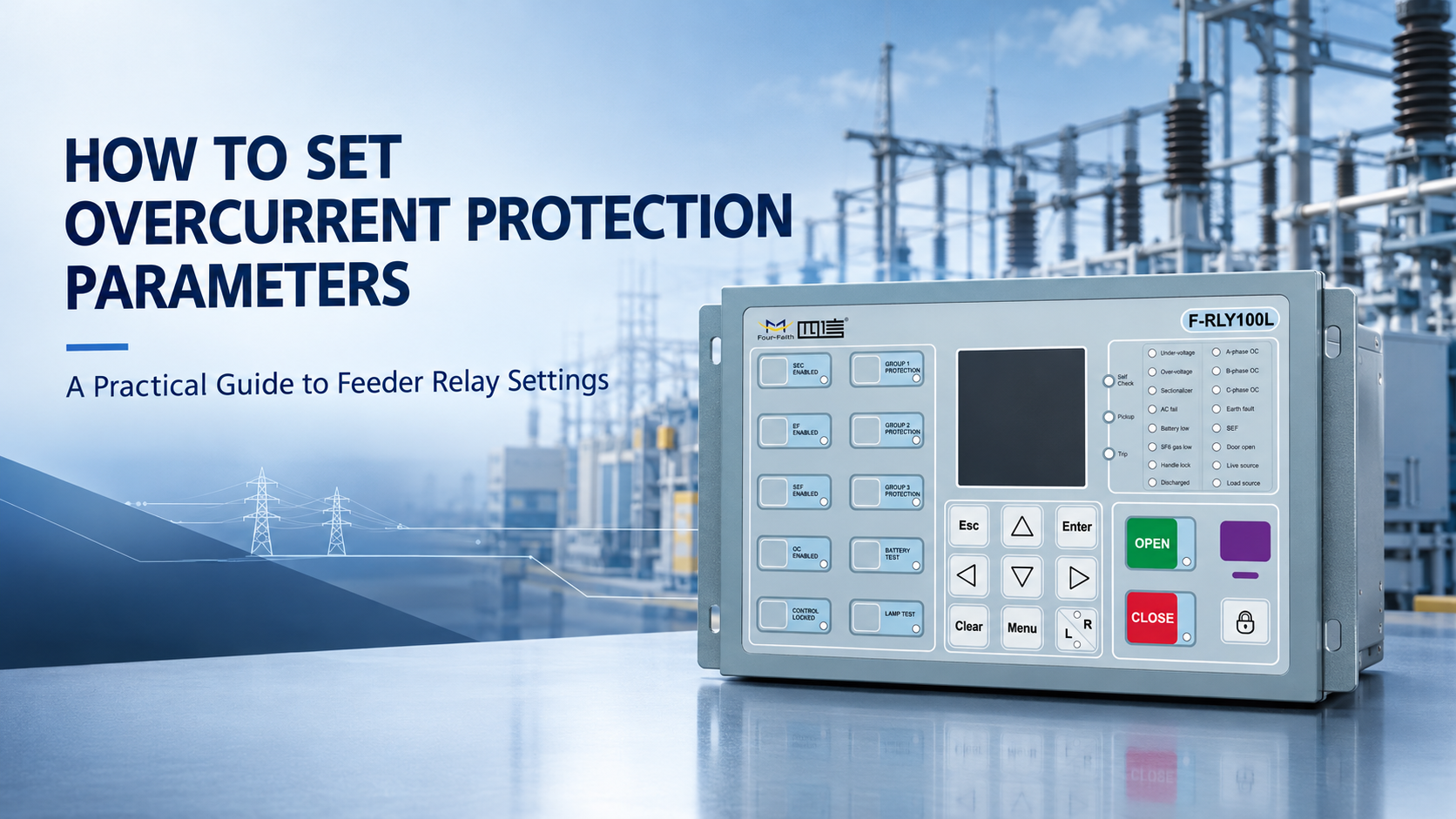
The F-RLY100L is a compact and intelligent feeder protection and control device designed for power distribution systems.
It combines:
- Protection
- Control
- Measurement
- Communication
within a single unit.
Its compact design makes it suitable for applications where installation space is limited while maintaining the protection and monitoring functions required for modern distribution networks.
The F-RLY100L is designed to provide reliable feeder protection while supporting the operational and communication requirements of intelligent power distribution systems.
https://www.fourfaithpower.com/up/2022/09/26/1664178968375889.png
F-RLY200 Feeder Protection Relay
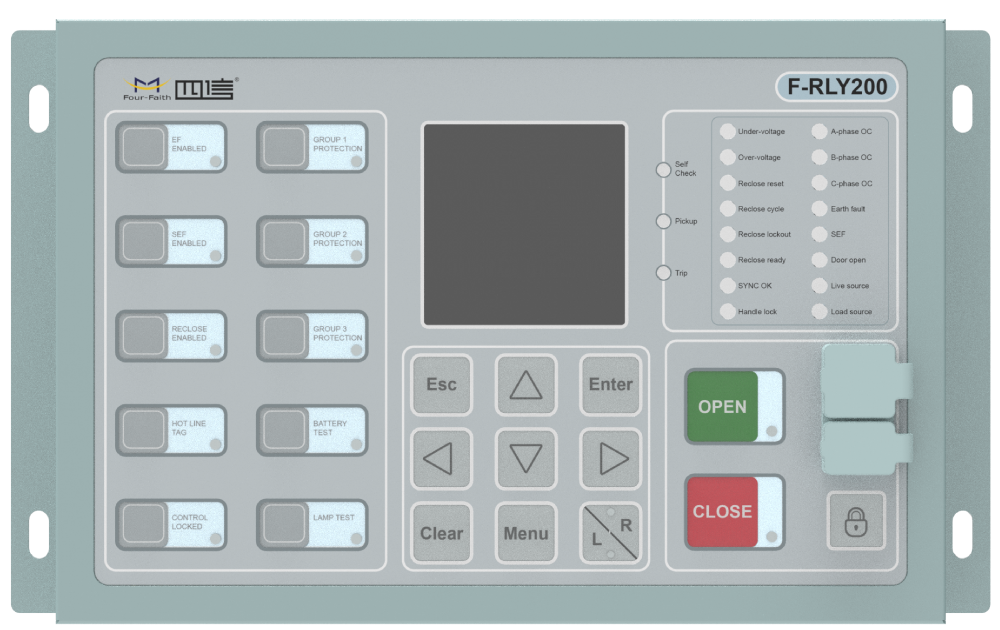
The F-RLY200 is a feeder protection and control relay designed for utility and industrial distribution systems.
It integrates:
- Protection
- Measurement
- Monitoring
- Control
- Communication
- Data handling
- Distribution automation
in one device.
This combination allows the F-RLY200 to serve not only as a feeder protection device but also as part of a broader digital distribution automation system.
For utility and industrial applications requiring protection together with monitoring, control, communication, and automation, the F-RLY200 provides an integrated approach to feeder management.
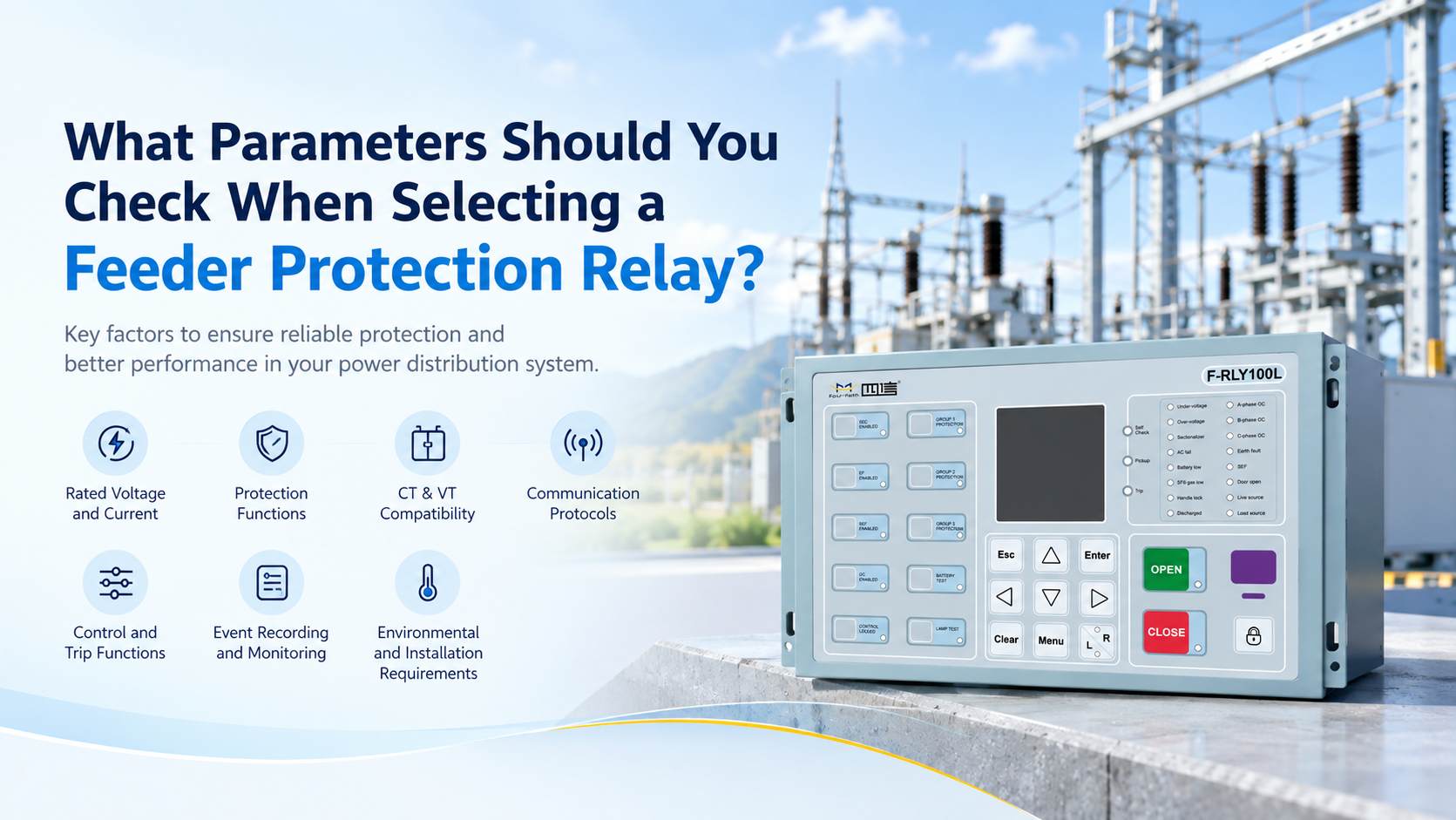
If you are selecting a feeder protection relay for a new distribution project, the required protection functions, network topology, voltage level, fault characteristics, communication protocols, and automation requirements should be evaluated before selecting the appropriate model.

top
- Products
- Distribution Automation
- Outdoor Apparatus
- Fault Circuit Indicator
- Industrial Wireless Communication
- Software
- Solutions
- Utility Solutions
- Infrastructure Solutions
- Services
- Documents & Software
- Support
- Business Case
- Video
- about us
- Company
- Contact us
- Subscribe
- Career

Mobile viewing


© Copyright 2026 by www.fourfaithpower.com. All Rights Reserved. 闽ICP备08106834号-8