






News
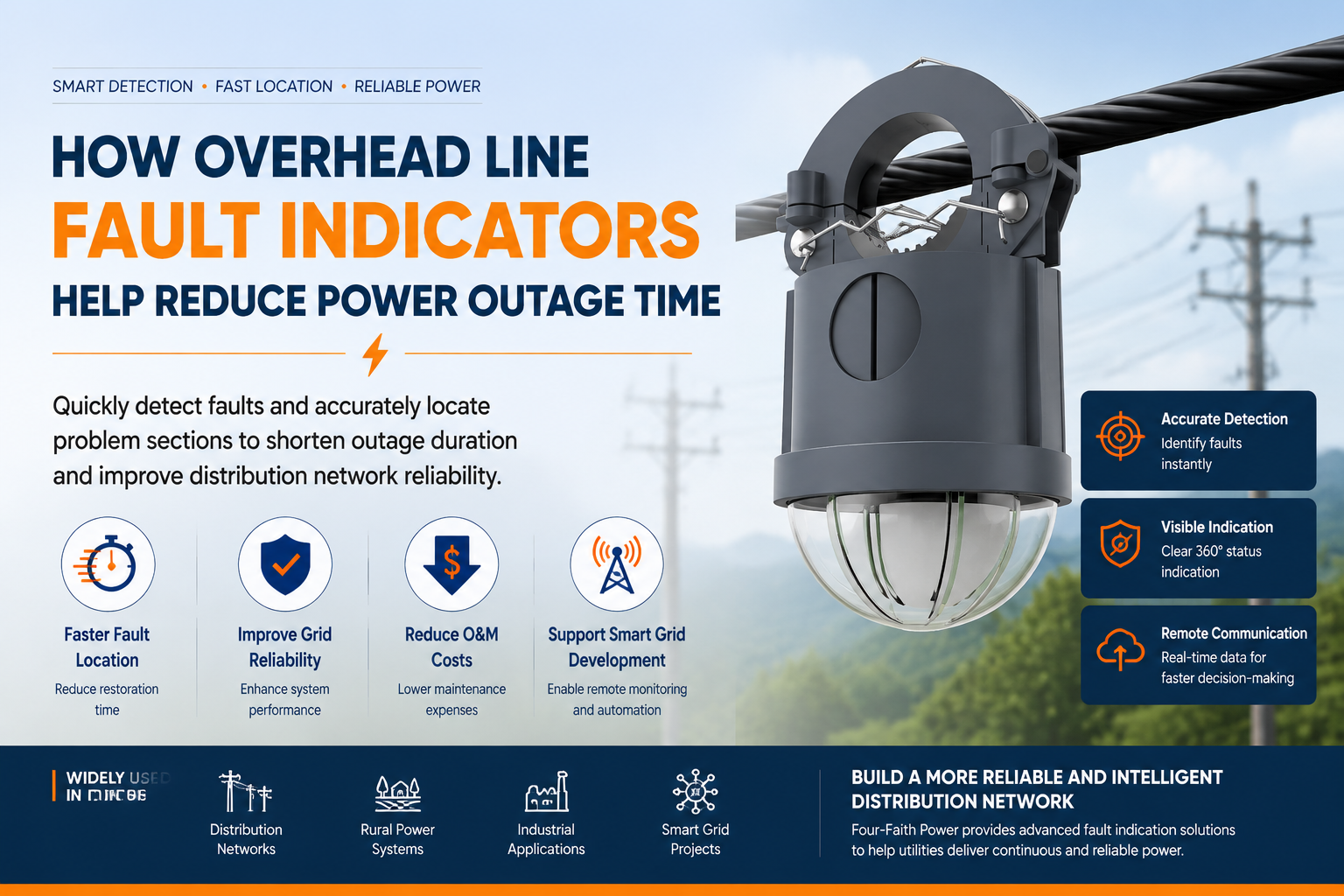
How Overhead Line Fault Indicators Help Reduce Power Outage Time
Date:2026-07-30
Power outages caused by overhead distribution line faults can lead to significant economic losses, customer dissatisfaction, and increased pressure on utility operators. For traditional distribution networks, locating the exact fault point is often time-consuming because maintenance teams need to inspect long sections of overhead lines manually.
Overhead line fault indicators provide a faster and more efficient way to identify fault locations, helping utilities shorten outage recovery time and improve power supply reliability.
Reduce Fault Location Time and Accelerate Power Restoration
One of the biggest challenges during a power outage is determining where the fault has occurred.
In conventional maintenance methods, operators usually need to patrol the entire overhead line section to locate problems such as:
- Short circuits
- Ground faults
- Line-to-line faults
- Equipment failures
This process can take hours, especially for long-distance rural distribution networks.
With overhead line fault indicators installed along the network, maintenance teams can quickly identify the faulted section based on the indication signals. This significantly reduces troubleshooting time and allows repair crews to reach the problem area faster.
Minimize the Impact Area of Power Outages
When a fault occurs in a distribution network, quickly isolating the affected section is critical.
Fault indicators help operators determine:
- Which line section is affected
- Where the fault is located
- Which areas can continue receiving power
By improving fault identification accuracy, utilities can avoid unnecessary shutdowns of healthy sections and reduce the impact range of outages.
Improve Distribution Network Reliability
Frequent and prolonged outages can reduce customer satisfaction and affect the reliability performance of utility companies.
Overhead line fault indicators support utilities by providing:
- Faster fault response
- More efficient maintenance operations
- Reduced outage duration
- Improved power supply continuity
For modern distribution networks, faster restoration is an important factor in achieving higher reliability levels.
Reduce Operation and Maintenance Costs
Traditional fault searching requires significant manpower and resources.
Maintenance teams may need to:
- Dispatch multiple inspection crews
- Travel long distances
- Spend additional time identifying fault points
By providing accurate fault location information, overhead line fault indicators reduce unnecessary field inspections and help utilities optimize maintenance processes.
This means lower operational costs while improving service efficiency.
Support Smart Grid and Distribution Automation Development
As power networks become more intelligent, real-time monitoring and automation are becoming increasingly important.
Overhead line fault indicators can work together with distribution automation systems to provide:
- Remote fault monitoring
- Real-time status information
- Faster outage management
- Improved grid operation efficiency
By integrating fault indicators into smart grid solutions, utilities can move from traditional manual maintenance toward more intelligent and automated network management.
Improve Customer Power Supply Experience
For electricity users, the most important factor during an outage is how quickly power can be restored.
By shortening fault detection and repair time, overhead line fault indicators help:
- Reduce customer outage duration
- Improve electricity service quality
- Increase customer satisfaction
This is especially valuable for regions with large overhead distribution networks and challenging geographic conditions.
Conclusion
Overhead line fault indicators play an important role in reducing power outage time by enabling faster fault detection, improving maintenance efficiency, and supporting smarter distribution network management.
For utilities seeking to enhance reliability and reduce operational challenges, deploying advanced fault indication solutions is an effective way to build a more resilient and efficient power distribution system.
Reliability is one of the most important challenges in modern power distribution networks. Electrical faults caused by lightning, vegetation contact, equipment failures, and external interference can interrupt power supply and affect consumers.
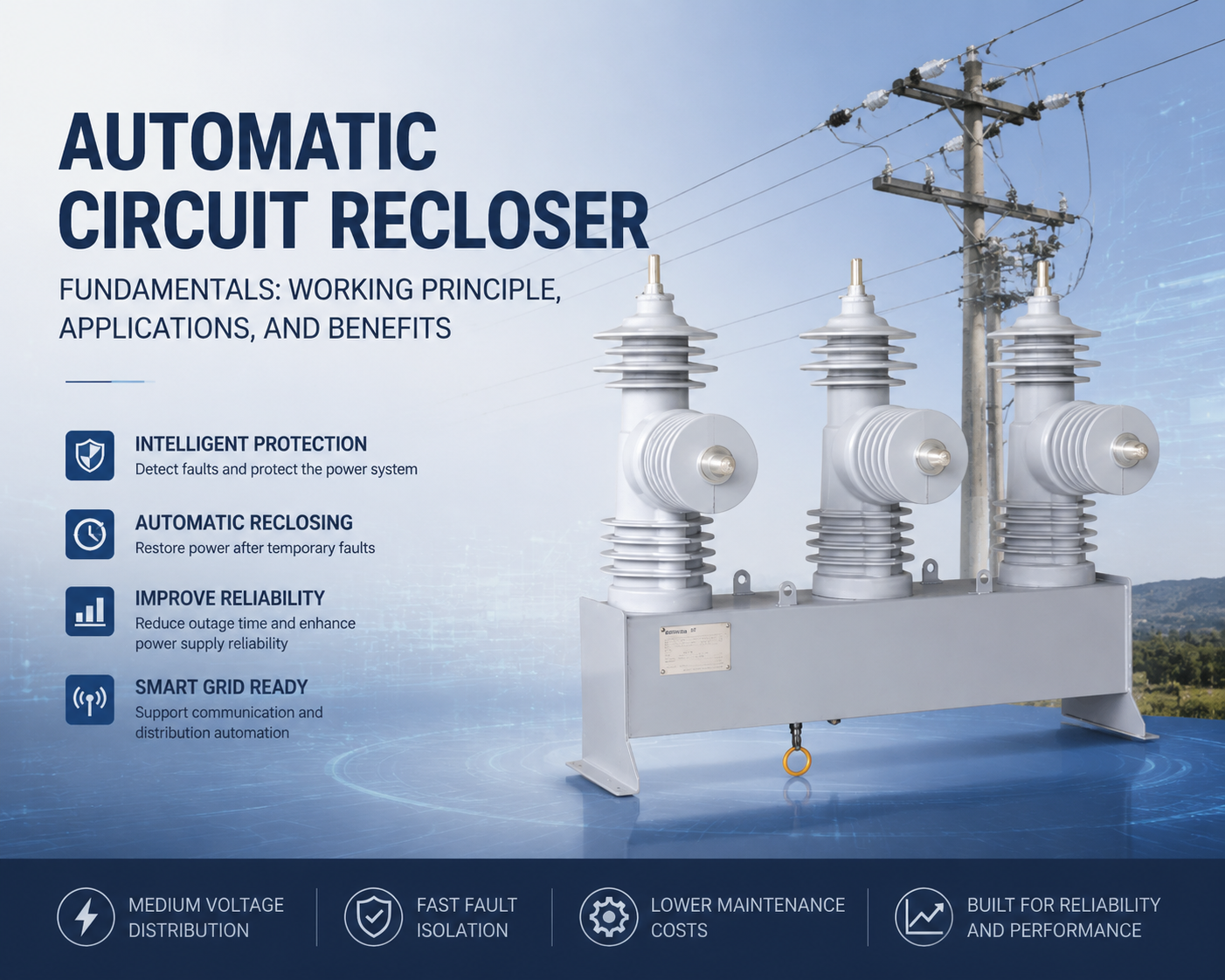
An automatic circuit recloser is an intelligent medium voltage protection device designed to detect faults, interrupt fault currents, and automatically restore power when conditions return to normal.
By combining switching, protection, and automation functions, automatic circuit reclosers help utilities improve grid reliability, reduce outage duration, and build smarter distribution networks.
1. What Is an Automatic Circuit Recloser?
An automatic circuit recloser (ACR) is an automatic switching device used in medium voltage distribution networks to protect electrical lines from faults.
Unlike traditional circuit breakers that normally require manual operation after tripping, reclosers can automatically perform multiple opening and closing operations according to predefined protection settings.
Main functions:
- Detect abnormal electrical conditions
- Interrupt fault current
- Automatically restore power after temporary faults
- Isolate permanent faults
2. Why Are Automatic Circuit Reclosers Used in Medium Voltage Networks?
Temporary faults such as lightning strikes, tree contact, and animal interference can disappear automatically. Automatic reclosers restore power without manual intervention.
Permanent faults such as damaged cables or equipment failures require isolation and maintenance.
3. How Does an Automatic Circuit Recloser Work?
Step 1: Monitoring Normal Network Conditions
The recloser continuously monitors current, voltage, and frequency.
Step 2: Fault Detection and Circuit Opening
When abnormal conditions occur, the recloser opens the circuit to protect equipment.
Step 3: Automatic Reclosing Operation
The device attempts to restore power after a preset time.
Step 4: Lockout Protection
If the fault remains, the recloser stays open until repair.
4. Main Components of an Automatic Circuit Recloser
Switching Unit
Responsible for opening and closing circuits.
Protection Controller
Provides fault detection, protection coordination, and event recording.
Current and Voltage Sensors
Provide real-time electrical measurements.
Communication System
Supports remote monitoring, SCADA integration, and smart grid applications.
5. Applications of Automatic Circuit Reclosers
- Feeder automation
- Utility distribution networks
- Renewable energy integration
- Industrial power systems
6. Automatic Circuit Recloser in Distribution Automation Systems
Modern intelligent distribution networks combine automatic circuit reclosers with protection relays, RTUs, communication equipment, and fault location systems.
This enables remote monitoring, faster fault isolation, and improved grid management.
7. Benefits of Automatic Circuit Reclosers
- Improved Power Reliability
- Reduce unnecessary power interruptions.
- Reduced Outage Duration
- Automatically clear temporary faults.
- Improved Operational Efficiency
- Reduce manual inspection requirements.
- Smart Grid Support
- Enable intelligent monitoring and automation.
8. How to Select the Right Automatic Circuit Recloser?
Consider:
- Voltage level
- Rated current
- Protection functions
- Communication capability
Conclusion
Automatic circuit reclosers are fundamental components of modern medium voltage distribution networks. By combining protection, switching, and automation capabilities, they help utilities reduce outages, improve reliability, and enhance grid intelligence.
Four-Faith provides integrated medium voltage distribution solutions, including automatic circuit reclosers, load break switches, fault indicators, distribution automation equipment, communication devices, and intelligent software systems.

top
- Products
- Distribution Automation
- Outdoor Apparatus
- Fault Circuit Indicator
- Industrial Wireless Communication
- Software
- Solutions
- Utility Solutions
- Infrastructure Solutions
- Services
- Documents & Software
- Support
- Business Case
- Video
- about us
- Company
- Contact us
- Subscribe
- Career

Mobile viewing


© Copyright 2026 by www.fourfaithpower.com. All Rights Reserved. 闽ICP备08106834号-8