






News
How to Choose the Right Feeder Protection Relay?
Date:2025-12-17
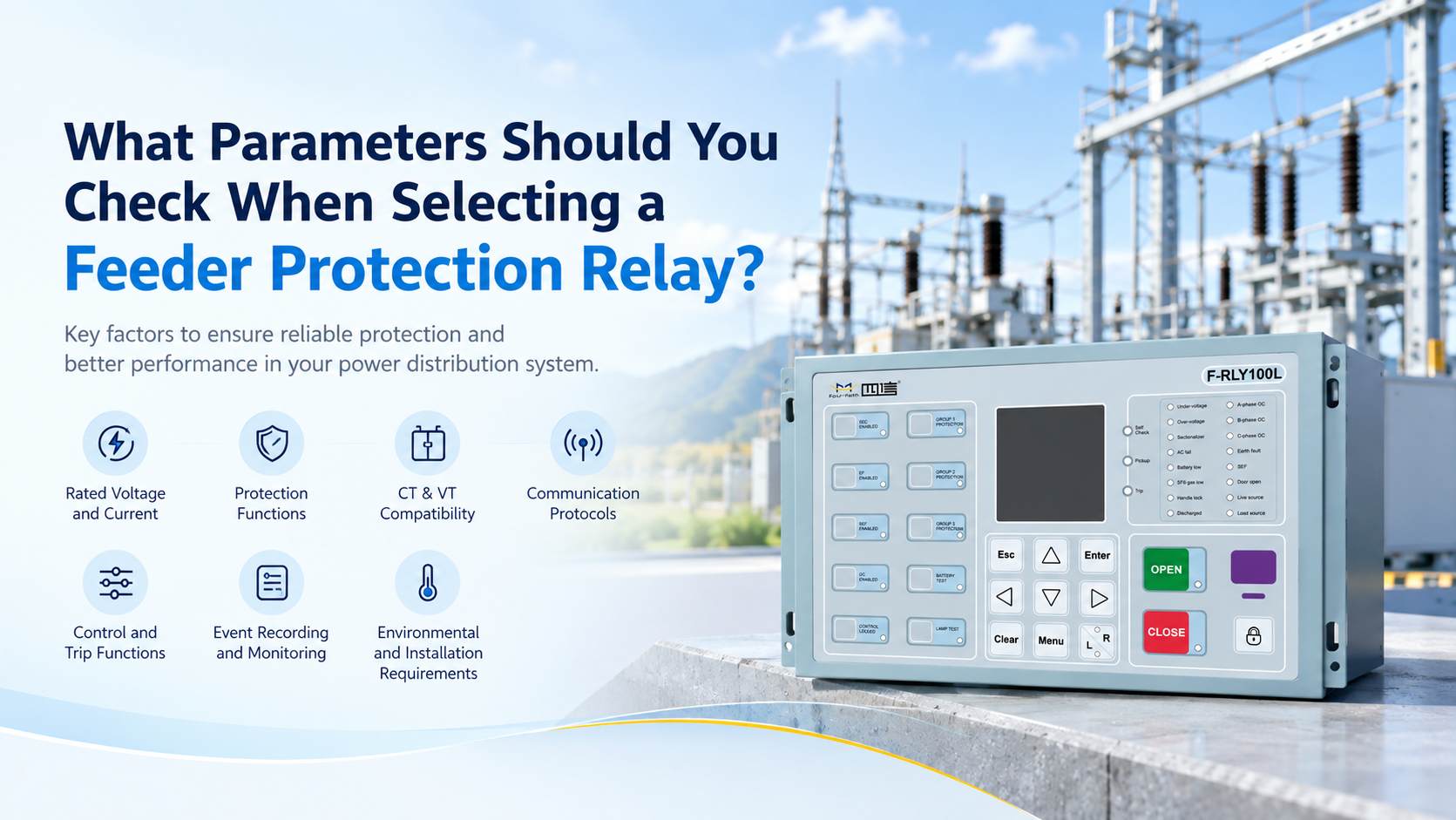
Choosing the right feeder protection relay is critical for ensuring the safety, reliability, and efficiency of power distribution systems. A well-selected relay helps detect faults accurately, isolate affected feeders quickly, and minimize equipment damage and downtime.
This article outlines the key factors to consider when selecting a feeder protection relay and helps engineers make informed decisions based on application requirements.
1. Understand the Feeder Type and Application
The first step is to clearly define the feeder and its operating environment.
Key questions include:
Is the feeder overhead or underground?
Is it part of a radial, ring, or meshed network?
Is it used in industrial plants, substations, or utility distribution networks?
What is the voltage level (low, medium, or high voltage)?
Different feeder configurations require different protection philosophies. For example, radial feeders often use simpler overcurrent protection, while ring or meshed networks may require directional or differential protection.
2. Determine Required Protection Functions
Feeder protection relays can include multiple protection elements. The selection should match the fault types and system risks.
Common protection functions include:
Overcurrent protection (50/51) – for phase faults
Earth/ground fault protection (50N/51N or 64) – for insulation failures
Directional overcurrent protection (67/67N) – for systems with multiple power sources
Negative sequence protection (46) – for unbalanced loads
Breaker failure protection (50BF)
Thermal overload protection (49)
Not all feeders need all functions. Selecting only necessary features helps control costs and reduce complexity.
3. Evaluate System Parameters
Accurate relay performance depends on correct system data.
Important parameters include:
Rated current and voltage
Short-circuit levels
CT and VT ratios
System grounding method (solid, resistance, or isolated)
Ensure the relay’s measurement range and accuracy match the system values to avoid maloperation or insufficient sensitivity.
4. Consider Communication and Integration Requirements
Modern feeder protection relays often support communication protocols for monitoring and control.
Common protocols include:
IEC 61850
Modbus
DNP3
IEC 60870-5-103
If the relay needs to integrate with a SCADA or substation automation system, compatibility is essential. IEC 61850 support is increasingly important for digital substations and future-proof system design.
5. Reliability, Standards, and Certifications
Feeder protection relays should comply with relevant international standards, such as:
IEC 60255
IEEE C37 series
In addition, consider:
Manufacturer reputation
Proven field performance
Mean time between failures (MTBF)
Availability of technical support and spare parts
Reliability is especially critical in utilities and continuous industrial processes where outages are costly.
6. Ease of Setting, Operation, and Maintenance
User-friendly configuration and maintenance reduce engineering time and operational risk.
Look for:
Intuitive setting software
Clear event and fault records
Disturbance and waveform recording
Simple commissioning and testing procedures
Advanced diagnostics and self-monitoring functions can significantly improve maintenance efficiency.
7. Cost vs. Long-Term Value
While initial cost is an important factor, it should not be the only consideration.
A higher-quality feeder protection relay may offer:
Longer service life
Fewer false trips
Lower maintenance costs
Better system availability
Evaluating total cost of ownership (TCO) often leads to better long-term decisions.
Conclusion
Choosing the right feeder protection relay requires a balance between technical requirements, system characteristics, and long-term reliability. By carefully analyzing the feeder type, protection functions, system parameters, communication needs, and operational considerations, engineers can select a relay that ensures safe and efficient power distribution.
A well-chosen feeder protection relay not only protects equipment but also supports stable system operation and future expansion.
Learn More About Our Feeder Protection Relay Solutions
Selecting the right feeder protection relay is not only about meeting today’s protection requirements, but also about ensuring long-term reliability and scalability of your power system.
Our feeder protection relays are designed to support a wide range of distribution applications, combining comprehensive protection functions, accurate measurement, and flexible communication capabilities such as IEC 61850. With a focus on reliability, ease of configuration, and seamless integration into modern substation and industrial automation systems, our solutions help engineers build safer and more efficient power networks.
To learn how our feeder protection relays can be applied in your specific project, explore our product range or contact our technical team for detailed specifications and application support.

top
- Products
- Distribution Automation
- Outdoor Apparatus
- Fault Circuit Indicator
- Industrial Wireless Communication
- Software
- Solutions
- Utility Solutions
- Infrastructure Solutions
- Services
- Documents & Software
- Support
- Business Case
- Video
- about us
- Company
- Contact us
- Subscribe
- Career

Mobile viewing


© Copyright 2026 by www.fourfaithpower.com. All Rights Reserved. 闽ICP备08106834号-8